SomaFlow Simplified

SomaFlow is not a workout.
It’s a way of understanding how the body actually works.
Most people haven’t lost strength.
They’ve lost organisation.
They’ve been taught to hold themselves together.
To brace.
To engage.
To control movement in order to feel stable.
And over time, that creates a body that feels tight, disconnected, and unreliable.
The more effort they use,
the less supported they feel.
SomaFlow exists to interrupt that pattern.
Not by adding more effort —
but by restoring the body’s ability to organise itself.
The System
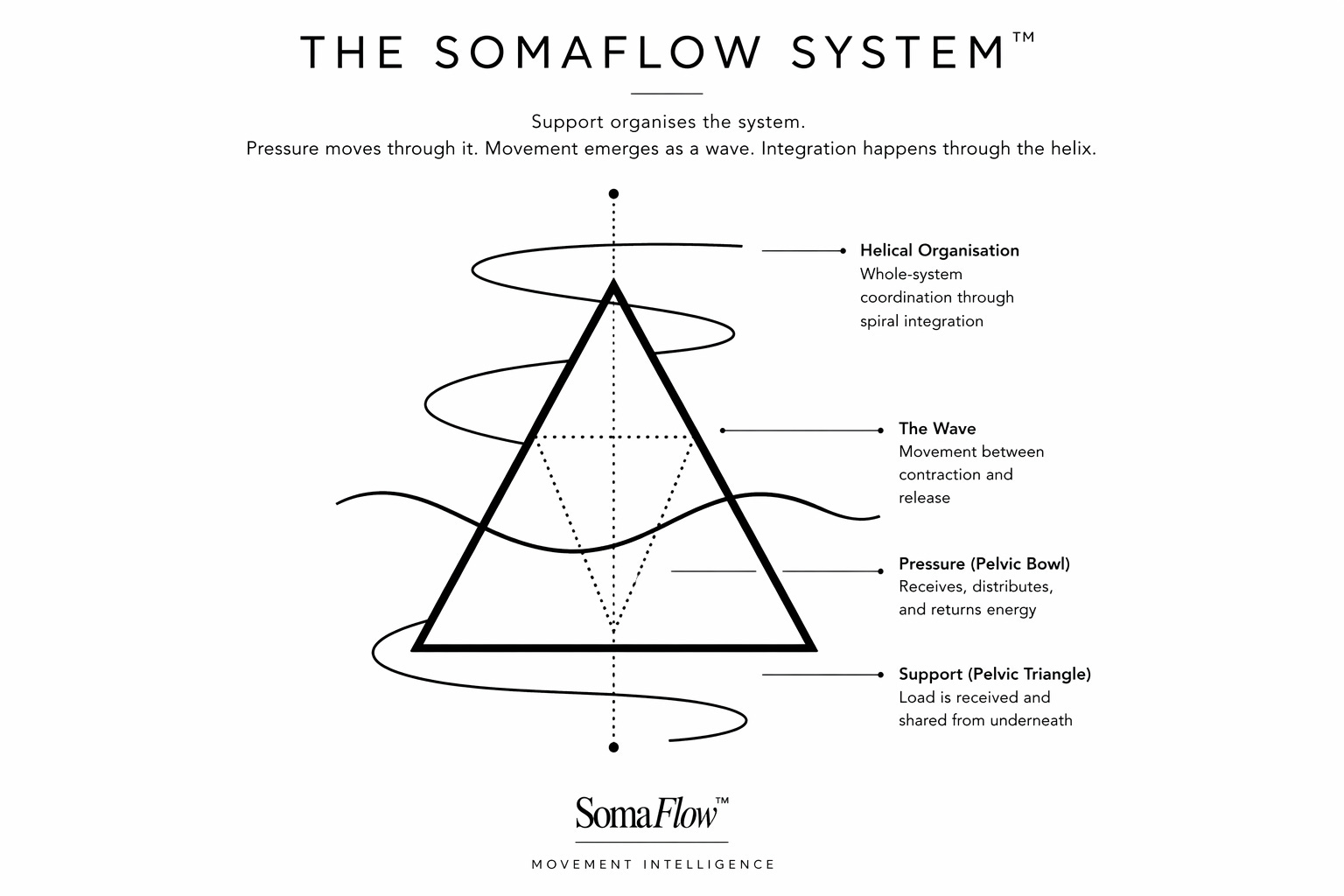
At its core, SomaFlow is built on a very simple sequence:
Support creates the conditions for pressure to move.
Pressure creates the conditions for movement.
Movement creates the conditions for integration.
Everything comes back to that.
If the body is not supported,
it compensates.
It grips.
It braces.
It overworks.
When support is present,
the system doesn’t need to fight.
It can respond.
Where Support Begins
Support doesn’t come from the core.
It comes from underneath.
We call this the pelvic triangle of support.
It’s the relationship between:
the glutes
the hamstrings
the inner thighs
Together, they create a base that:
receives load
shares effort
and initiates movement
When this system is organised,
the body feels supported without gripping.
When it’s not,
everything shifts upward.
Into the lower back.
Into the shoulders.
Into effort.
How the Body Manages Pressure
Above that sits the pelvic bowl.
This is how the body organises pressure.
It’s not something you hold.
It behaves more like a responsive surface.
It receives pressure,
adapts to it,
and returns energy back into the system.
When the bowl is responsive:
movement feels supported
pressure flows
the body adapts
When it’s controlled:
pressure gets stuck
the system stiffens
movement becomes heavy
The Missing Piece
Most people can contract.
Very few people can release.
And without release,
the system cannot move.
This is where the wave comes in.
The pelvic floor is not a switch.
It’s not on or off.
It’s a continuous movement between:
contraction
and release
Between:
flatten
and arch
This is not something you perform.
It’s what emerges
when the system is no longer being controlled.
The Helix
When support is present,
when pressure can move,
and when the body is no longer holding—
movement stops being something you do.
And becomes something that organises itself.
The body doesn’t move in straight lines.
It moves in spirals.
This is what we call helical organisation.
It’s what allows:
force to be distributed
movement to feel fluid
the whole system to work together
Without it:
movement becomes segmented
effort becomes localised
things start to break down
Why This Matters
Most people are trying to fix movement
by adding more effort.
More activation.
More control.
More intensity.
But effort doesn’t create support.
It compensates for the lack of it.
SomaFlow flips that.
It teaches the body how to:
support itself
organise itself
and respond under load
So movement becomes:
lighter
more efficient
and more sustainable
How It’s Taught
We don’t teach positions.
We don’t teach perfect form.
We teach awareness.
Because the body doesn’t learn through instruction.
It learns through experience.
So instead of saying:
“hold this”
“engage that”
We guide people to feel:
where they’re gripping
where pressure isn’t moving
where support is missing
And when they feel it—
they change it.
The Outcome
The goal of SomaFlow is not performance.
It’s trust.
Not mental trust.
Structural trust.
The kind that comes from knowing your body can:
support itself
adapt under load
and move without strain
Over time:
effort reduces
movement becomes fluid
and the body becomes responsive
Not because you forced it.
Because you stopped interfering with it.
Final Line
SomaFlow is not something you do to your body.
It’s something your body begins to understand
when you give it the conditions to organise.